Straight answers for the social work team.
How we work, what we need from you, and what you can expect from us in return. If you are working on a referral, the fastest route is a direct call to Laura.
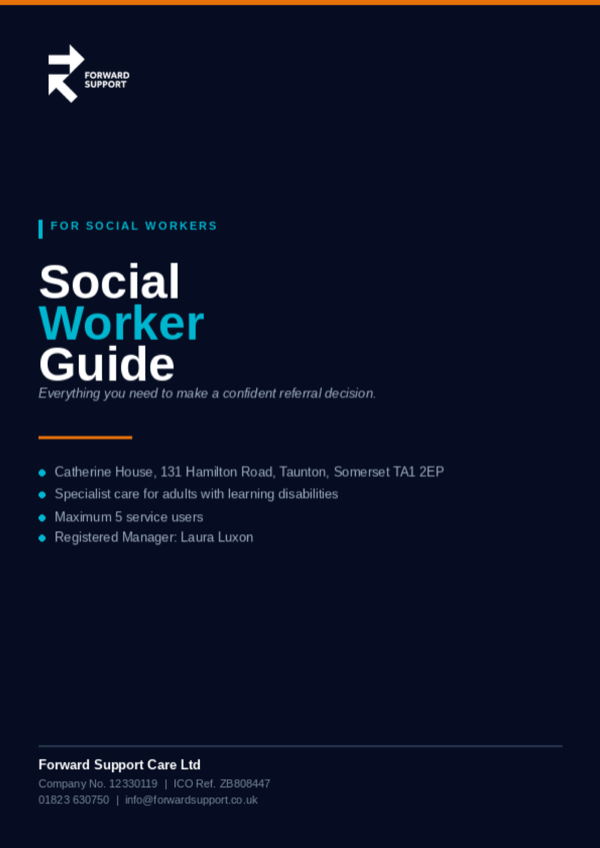
The Social Worker Guide
A concise PDF covering our referral process, the assessment pack we need, how placements are reviewed, our approach to MCA, PBS and safeguarding, and how to reach Laura directly. Written for the people making the decision, not for marketing.
Your download starts straight away, and we email you the link too.
The questions social workers ask us.
Honest, specific answers for the social work team. How we work, what we need from you, and what you can expect from us in return.
The starting point is a written referral with the standard assessment pack: social care assessment, health information, behaviour support plan if there is one, communication profile, and any current risk assessments.
If there is a recent Annual Health Check or LeDeR-related information, please include it. The more we see up front, the faster and more honestly we can answer whether we are the right fit.
Once we have reviewed the pack, the next step is usually a meeting at the person's current placement (or home), then a visit to Catherine House.
We consider emergency placements, but with the same care we give to planned ones. We will only say yes if we believe the placement could be sustained long-term, not just held as a stop-gap.
We have seen the damage that comes from emergency placements that are not right. We will not add to that. If the fit is not there, we will say so quickly so you can move on to alternatives without losing time.
We work to the Mental Capacity Act 2005 framework (QCS policy CR88). Capacity is assumed unless evidence suggests otherwise. Where a person lacks capacity for a specific decision, we follow the Best Interests process properly.
For significant decisions, we involve the social worker, family or advocate, and where appropriate the GP, psychologist, or other professionals.
DoLS authorisations are tracked in our care management system and reviewed in line with their expiry dates. We notify the supervisory body of any concerns or breaches the same day.
Read more: What happens if you are not happy with the care →
Care plans are reviewed monthly, with fuller six-monthly and annual reviews, and straight away after any fall, accident or incident. Care plans are dynamic documents in Log My Care, not paper folders that get dusted off twice a year.
Statutory reviews with the social worker happen at the cadence the commissioning authority requires, usually annually with interim reviews where there are significant changes.
We send written updates whenever you ask for them. Anything urgent comes by phone the same day.
Closely. The social worker is part of the team around the person, not just an external contact. We share draft care plans, invite input on significant changes, and flag concerns early.
Where you spot something we have not, please tell us. We would rather hear it directly than read about it at the annual review.
We use Positive Behaviour Support wherever possible, in line with QCS policy CC141. Most challenging behaviour is communication. We look for the cause first, adapt environment and routine where it helps, and bring in specialists (Speech and Language Therapy, Psychology, Behaviour Support) when warranted.
Restraint of any kind is a genuine last resort, in line with QCS policy CR77 (Restrictive Practices Including Restraint and Physical Interventions), and any use is reported and reviewed.
We follow the statutory CQC notification list properly. Notifications are submitted within the required timeframes, and the social worker is informed of any notification that relates to the person you support.
Safeguarding alerts go via Somerset's Adult Safeguarding process. Laura is the designated lead. We notify the local authority, CQC, and the person's social worker as appropriate, the same day where required.
If someone needs to go to hospital, a member of staff goes with them. We have someone on call seven days a week, and at night they come in to look after the other residents, so the person going to hospital still has someone they know with them.
We share the Hospital Passport, Communication Profile, and current medication record on arrival.
We stay in touch with the ward during admission, attend discharge planning where it helps, and we do not accept discharge until we and the family are confident the right support is in place at home.
If a discharge changes the level of care needed, we discuss honestly with the social worker before agreeing to receive the person back.
You will hear from us when there is something to say, not on a fixed quarterly schedule. Written updates whenever you ask for them. Anything urgent or worrying, a phone call the same day.
If you prefer a different cadence (more, less, written-only, phone-only), tell us. We adapt to how social workers actually work.
We escalate early, openly, and at the right level. The first conversation usually happens between Laura and you, the social worker, as soon as a concern emerges.
We document what is not working and what we have tried, work jointly on the right next step, and we do not issue notice as a first move. Where the right outcome is for the person to move, we manage that transition properly alongside you, the new provider, and the family.
We do not sit on problems hoping they will improve.
Read more: What happens if you are not happy with the care →